The problem
How does an insurer know that the patient in a clinic is the member on the card, or that the patient came at all? A membership card proves only that someone holds it. Cards are lent to relatives, claims are filed for visits that never took place, and the insurer finds out months later, if ever. In schemes that cover millions of people, these losses decide whether the scheme is sustainable.
What you get
Member enrollment without documents
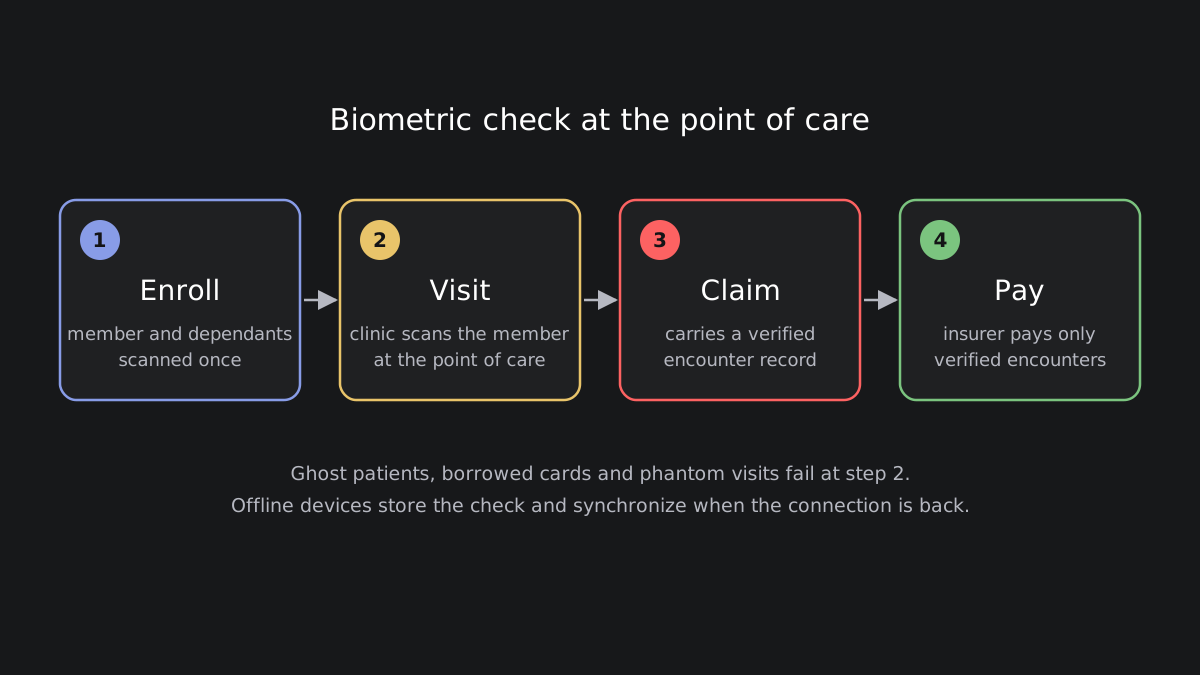
Members and their dependants are enrolled once with iris, face or fingerprint. The system checks that the person is not already registered under another number, so a second membership for the same person is flagged before it is issued.
Verification at the point of care
The clinic scans the member at the visit, and the verified encounter is attached to the claim. This is the step where borrowed cards and phantom visits are stopped.
Works where the internet does not
Rugged tablets and USB scanners with the Edge service keep verifying offline and synchronize when the connection is back. Existing smart cards are still supported.
Integration with claims systems
Verification results go into your claims management or e-claims platform over an API, so the payment rule becomes simple: verified encounters are paid, the rest are reviewed.
Why iris
Health insurance covers the elderly, children and manual workers, exactly the people whose fingerprints are worn or not yet formed. Iris capture is contactless, which matters in a clinic, and it separates people well enough to de-duplicate a national member register. Where a fingerprint infrastructure already exists, we add iris as a second modality instead of replacing it.
Deployment
Hardware
USB iris scanners from €139 for clinics with a PC, rugged BIOSID tablets with fingerprint, iris, face and smart card reading for field enrollment and rural facilities.
Where the data lives
On your servers or in a national data center, with biometric images in ISO formats. Biometric data is stored apart from medical and personal records, encrypted and pseudonymized.
How we start
We recommend starting with a pilot in a group of facilities with the highest claim volumes. Members are enrolled at their next visit, and for a few months claims from these facilities are compared with a control group. This way you measure the effect on your own data before a national rollout.