The problem
How does a lender know that a new applicant is not a former borrower under another name? A document shows a name and a photo, but documents can be borrowed or bought, and many first-time borrowers have none. The loss is specific: the same person takes loans under different names and repays none of them.
The effect starts before the first match
Why did repayment grow in Malawi? The lender did not share data with anyone. Borrowers simply knew that this lender would recognize them under any name, so a default could not be left behind by coming back as someone else. The researchers found that the riskiest borrowers took smaller loans and diverted less of the inputs the loans were meant for. Ghana's national health insurer described the same mechanism: an official called its biometric system psychologically a deterrent. A scan at application is a clear signal to the borrower, and this effect does not depend on the size of the database.
What you get
Onboarding on the phone
Face capture, passive liveness and selfie-to-document comparison inside your app with the open-source Biometric SDK (Android, iOS, React Native). No per-check fees, and images do not have to leave the device.
De-duplication in your portfolio
Each new applicant is searched against every borrower you have enrolled. A second account under another name is flagged before the loan is issued, and existing duplicates surface as borrowers come back.
Agents and branches offline
A USB iris scanner on the laptop or Android tablet the agent already uses, with the Edge service. It keeps working without a connection and synchronizes later.
A history tied to the person
Repayment history in your portfolio belongs to the person, not to a document number. A good borrower keeps their record when they change a phone or an ID card, and a defaulter cannot start again with a clean name.
How it works for the borrower
- Enroll once. At the first visit the agent scans the borrower's eye. The system checks that this person is not already registered with you and saves the iris template to the profile.
- Confirm identity in seconds. Next time the borrower looks at the camera, and the system returns the profile. For routine operations no ID card is needed.
- Get the loan. The decision is based on a verified identity and a repayment history that cannot be moved to a new name.
Deployment
Hardware
Monocular USB iris scanners from €139, dual-iris cameras for branches, rugged BIOSID tablets for the field. Face on any smartphone.
Where the data lives
Our Cloud Iris API for a quick start, or the same matcher on your servers if regulation requires data to stay in the country. Iris and face images are stored in ISO formats, so any other vendor can build its own templates from them, and you are not tied to us.
How we start
We recommend a short pilot: enroll a few thousand existing borrowers at several agents and run de-duplication against them. In a few weeks you get the number of duplicate identities in your portfolio, the false rejection rate on your own population and hardware, and the cost per check. New applicants are enrolled at the same time, so you can compare their repayment with borrowers who joined before. This gives you the business case before any large investment.
Next: a shared check between lenders
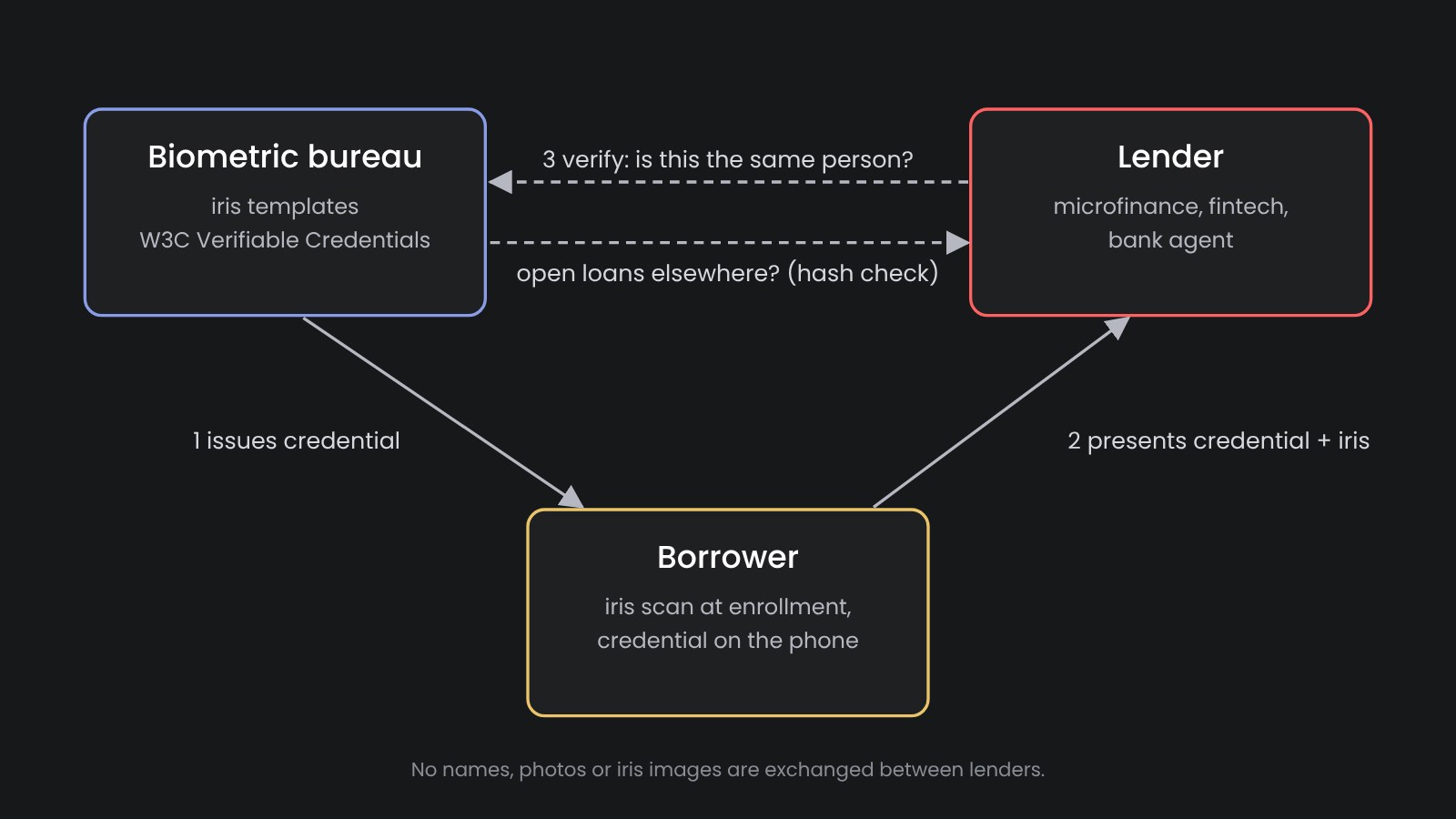
Fraudsters move between lenders, and one lender's database cannot see that. When several lenders use the same identification, they can ask "does this person have an open loan elsewhere?" without exchanging names, photos or iris images. In the EU-funded INGRESS project we built a prototype of it: a biometric bureau that issues verifiable credentials bound to a person, and a credit bureau that keeps loan records. It makes sense once several lenders in a market take part, and the template enrolled in your pilot is the same one it will use.