In plain words
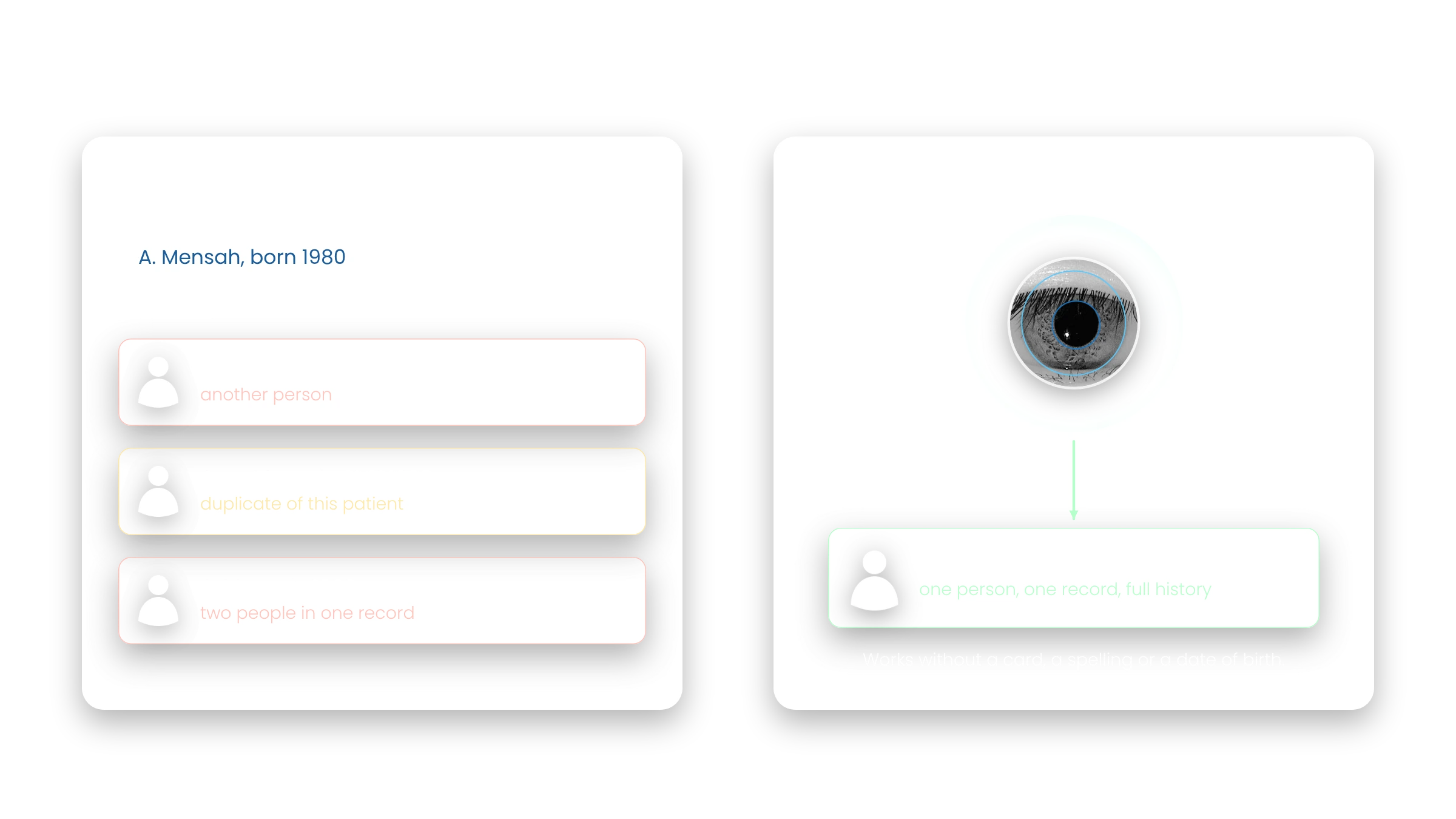
A patient gives her name at the desk. The desk finds two records with that name, or none, and opens a new one. Now her allergies and test results sit in two files, and the doctor sees only half of them.
- At the desk. The patient looks into a small scanner for a few seconds. Nothing touches the eye.
- The right record opens. The system finds the patient by their eyes, not by name or card. A new patient gets a record only after the system confirms there is none yet.
- One history. Every visit, test and prescription goes into that one record, whoever is on shift.
An example with round numbers
Suppose your clinic registers 1,000 new patients a month, and 5 of every 100 already have a record the desk did not find. That makes 50 duplicate records a month. If each takes a staff member an hour to find and merge later, you lose 50 hours a month, or $500 at $10 an hour, before counting repeated tests. The checks cost $99 a month, plus one USB scanner per registration desk from about $50. These numbers are an illustration; your clinic will have its own.
What you need to start
A USB iris scanner at each registration desk and a cloud plan; the starter kit covers one desk. Your hospital information system connects through an API, and we help with that part. A network of facilities begins with the desks of one of them.
See the starter kit Ask about a pilot
The problem
How does a registration desk find the right record? Usually by name, date of birth and sometimes a card number. When two patients share a name, the wrong record opens. When the desk finds nothing, a second record is created, and the patient's history is split in two. When a patient uses someone else's card, the history of two people is mixed in one. Each of these errors ends up at the bedside or in a claim.
What you get
Identification at registration
The patient looks at a scanner, and the system returns the record. No spelling of names, no searching by date of birth, no card to forget.
No duplicate records
Every new registration is searched against all enrolled patients, so a returning patient does not get a second record by accident, and getting one on purpose becomes much harder. Older duplicate files are found when a returning patient is linked to them: staff confirm which existing records belong to the person, and those records are merged under one enrollment.
Checks where errors are made
The same identification before medication, transfusion, sample collection and procedures, on a tablet at the bedside or a scanner in the lab.
Verified encounters for billing
The visit record carries the biometric check, so claims to insurers and national schemes are backed by proof that the patient was there. See health insurance.

Why iris
A hospital needs contactless identification, and it needs it to work for the elderly, for manual workers with worn fingerprints and for patients who cannot hold a finger still. Iris is captured from a distance, changes little over adult life and separates people well enough to search a whole regional patient register. Face is available as a second modality for patients who cannot open their eyes for the scanner.
Deployment
Integration
An API and SDK for your hospital information system or EMR, including open-source systems, and an identity layer that can be shared by a network of facilities. USB scanners at desks, tablets in wards, offline mode for rural clinics with the Edge service.
Where the data lives
On hospital or ministry servers. Biometric templates are kept apart from medical records and linked by a pseudonymous identifier, so a leak of one database does not directly expose the other.
How we start
We recommend starting with the registration desks of one facility. For a few weeks returning patients are enrolled as they come, staff link each one to the files found under their name and documents, and you count how many of these patients turn out to have more than one record. This number is a clear argument for the rest of the rollout.