Biometric Verification in Health Insurance: Lessons from Ghana and Kenya
What does a health insurance scheme actually pay for? Not for treatment, but for claims: documents that describe a visit the insurer did not see, to a patient the insurer cannot recognize. When a membership card can be lent to a relative and a clinic can file a claim for a visit that never happened, this gap costs schemes a significant part of their budget. Ghana and Kenya both turned to biometric verification to close it, and their experience shows both what works and what does not.
Where the money leaks
Health insurance fraud in such schemes usually takes a few typical forms:
- Card sharing. An uninsured person is treated under the card of an insured relative or neighbor.
- Ghost patients and phantom visits. A facility files claims for people who did not come, often using real member numbers.
- Multiple memberships. One person is registered several times, for example as a dependant in two households.
- Inflated claims. The visit was real, but the claim lists more expensive services than were provided.
Biometrics addresses the first three directly, because each of them depends on the insurer not knowing who was actually in the clinic. The fourth one is a different problem, and I come back to it below.
Ghana: biometrics as a deterrent
Ghana's National Health Insurance Scheme covers millions of members through the National Health Insurance Authority (NHIA). A case study by Emmanuel Owusu-Oware, John Effah and Richard Boateng of the University of Ghana, published at AMCIS 2018, describes how the NHIA introduced biometric membership enrollment and verification of members at health facilities. The authors cite an estimate that fraudulent claims by service providers made up 5–10% of claim costs.
The NHIA's deputy director of business systems for claims, interviewed for the study, called the biometric system psychologically a deterrent and estimated that claim volumes had dropped by approximately 15–16%. The study does not separate this effect from electronic claims and other measures introduced at the same time. Still, at the time of the study only about 1,300 of the 4,000 planned biometric kits were deployed at facilities.
The main conclusion of the authors is that the technology alone is not enough: fraud can be reduced when biometric verification at the point of care is combined with electronic claims and operational rules, such as clinicians vetting providers' claims. This way each part closes a gap that the others leave open.
Kenya: from private insurers to the national scheme
In Kenya the change started in the private sector. LCT Africa, a Nairobi startup, built a fingerprint-based platform that authenticates patients at hospitals for private insurers. By 2021, according to Business Daily, it had distributed more than 1,500 devices to hospitals including Nairobi Hospital and Aga Khan University Hospital, and the time to process claims had fallen from an average of four months to one day. The company said it had eased claims of about 26,000 users worth around KSh 100 million (about $932,000). The speed matters as much as the fraud: a claim backed by a verified visit does not need weeks of manual checking.
The national scheme followed. The Social Health Authority (SHA), which replaced the NHIF in October 2024, had more than 30 million registered members by May 2026. In August 2025 the government ordered to replace one-time-password authorization with biometrics, and by 2026 fingerprint authentication was required for all SHA claim approvals. Health Cabinet Secretary Aden Duale cited fraud patterns such as unusual multiple visits by the same individuals and questionable dependant registrations. By May 2026 more than 5,000 facilities had received biometric devices. Consider the scale: according to the 2026 Economic Survey, the scheme paid KSh 91.5 billion in claims in 2024/25, so even a few percent of fraud is a large amount of money.
What biometrics does not solve
Verification proves that the member was in the facility. It does not prove that the services in the claim were necessary or actually provided. Inflated claims and unnecessary procedures still require clinical review and data analysis, as the Ghanaian study emphasizes.
There are also practical risks. A facility without a working device or connection cannot verify, and if the rules are strict, patients are turned away or claims are rejected. Some people cannot be enrolled with a given modality: fingerprints of the elderly and manual workers are often worn. A scheme needs a fallback procedure and devices that work offline, otherwise biometrics excludes exactly the people it was supposed to protect.
Lessons for a new scheme
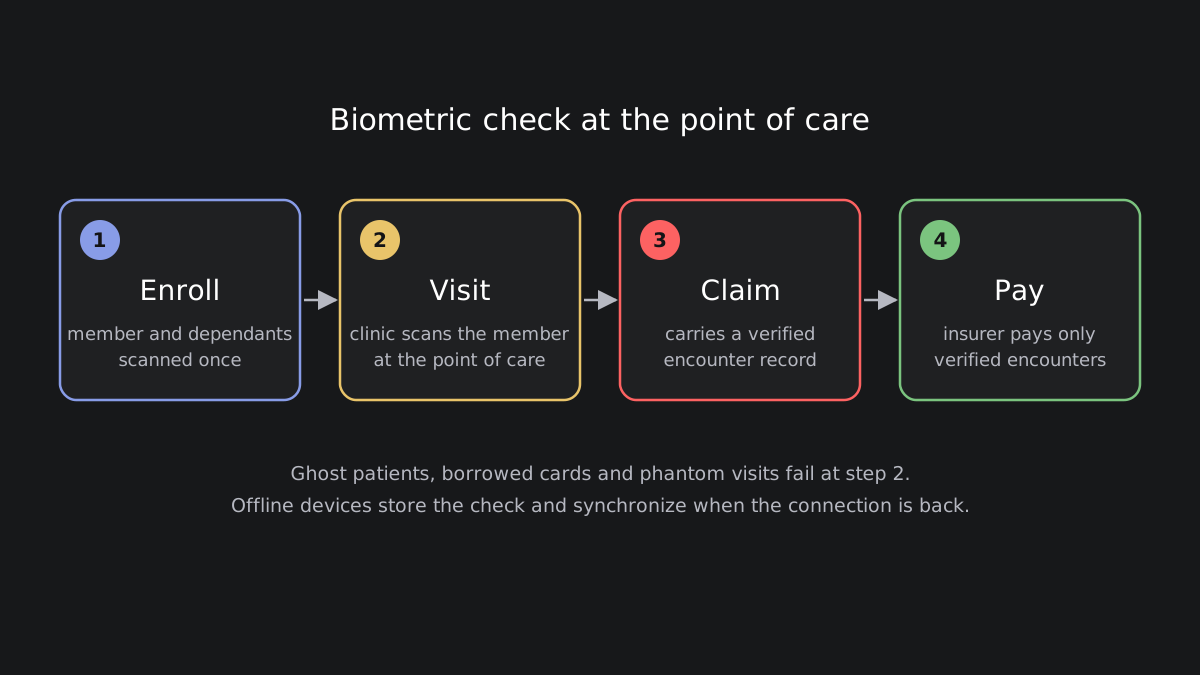
- Verify at the visit, not only at enrollment. A biometric card that nobody checks at the clinic stops very little.
- De-duplicate the member register. One person, one membership, including dependants.
- Plan for no connection. Devices should verify offline and synchronize later.
- Use more than one modality. Iris helps many people whose fingerprints fail, and it is contactless.
- Connect verification to claims. The payment rule becomes simple: verified encounters are paid automatically, the rest go to review.
- Treat biometric data as special. Store templates apart from medical records, encrypt them and define a retention period.
Sources: Owusu-Oware, Effah, Boateng, Biometric Technology for Fighting Fraud in National Health Insurance: Ghana's Experience, AMCIS 2018; Biometric Update, Startup's biometric system facilitates health insurance claims in Kenya, 2021; The Star, Biometric gadgets to curb fraud in SHA facilities, 2026; AllAfrica, Govt orders biometric SHA listing to replace OTP-based authorization, 2025.